In late November 2026, a generative AI feature called Recompose was discovered in Samsung's One UI 9.5 beta: after taking a photo, users can drag a finger to change the viewing angle, with the system first reconstructing a 3D scene on-device via depth mapping, then uploading to the cloud where generative AI fills in occluded regions. This marks the moment smartphone computational photography shifted from filter-style post-processing into the era of 3D-aware reconstruction. For OEM/ODM procurement and hardware engineers, camera module selection must now evaluate five new dimensions: depth data source quality, raw frame SNR and HDR, multi-camera calibration precision, module-to-ISP bandwidth budget, and on-device reconstruction power co-design — without them, even the strongest AI cannot deliver.
According to reports from Android Authority and The Verge on November 26-28, 2026, Recompose is built into Samsung's Photo Assist suite within the Photo Editor app, using a two-stage architecture. Stage one runs on-device: a companion app called Spatial Core (153MB, reportedly integrating ArcSoft 3D models) uses focal length and subject masking to generate a depth map and reconstruct the flat photo into a 3D scene. Stage two goes to the cloud: the original image and new viewpoint are sent to Samsung's servers, where a generative model — reportedly Google's Nano Banana 2 — fills in regions that were occluded at the original angle. SamMobile demonstrated the tool on a Galaxy S26 Ultra, and it is expected to ship with the Galaxy S27 series in early 2027.
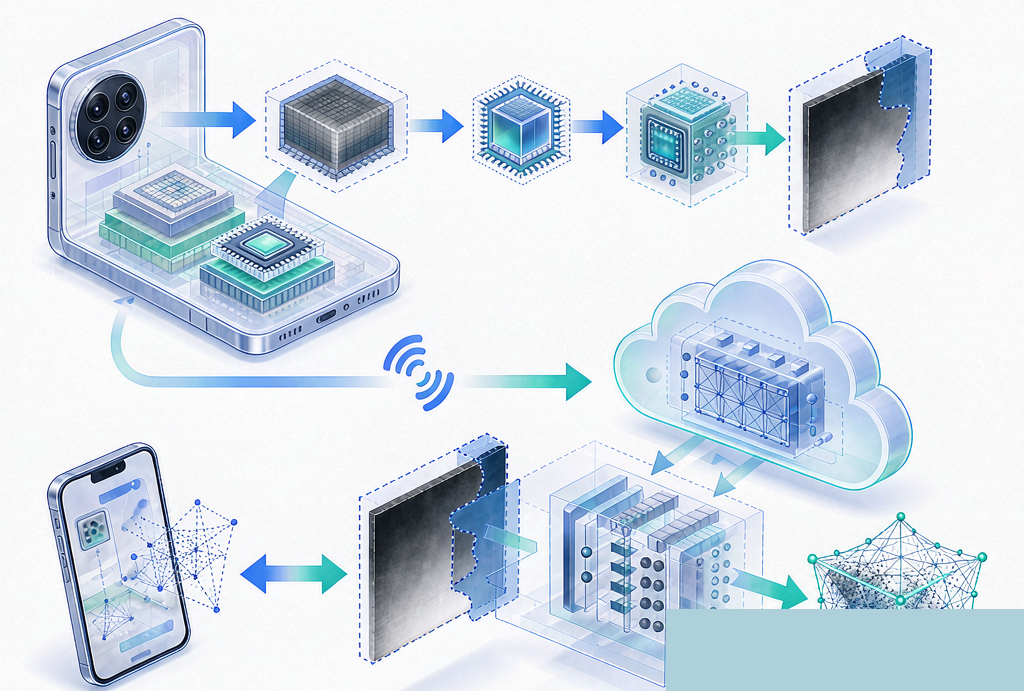
This is fundamentally different from Samsung's existing Generative Edit (which erases, moves, or resizes objects but keeps the viewpoint fixed) and Google's Auto Frame (which widens or reframes with AI fill but does not change the angle). Recompose changes the camera viewpoint itself. Achieving this requires capturing sufficiently high-quality depth information and raw image data at the moment of shooting — which is exactly a camera module-level question. For procurement and engineers, the old selection checklist built around megapixels, sensor size, and aperture is no longer enough.
The quality ceiling of 3D reconstruction is set by the depth data source. Recompose's on-device Spatial Core needs a reliable depth map to reconstruct scene geometry, and the depth source directly determines reconstruction accuracy and applicable scene range. Many procurement teams evaluate only whether depth capability exists, ignoring that reconstruction quality can vary by an order of magnitude across depth solutions.
Three mainstream depth sources exist today: dual-pixel phase detection (2PD), time-of-flight sensors (ToF/dToF), and multi-camera stereo vision. Their reconstruction performance differs significantly: 2PD relies on the main sensor's phase-detect pixels, with depth accuracy limited by baseline length and error growing rapidly for distant subjects; ToF/dToF offers high active ranging accuracy but suffers from multi-path interference and reduced effective range in strong light; multi-camera stereo depends on inter-camera baseline and calibration, costs more but is most robust for complex textured scenes. Selecting only on "supports depth" leads to visible geometric distortion at subject edges and distant objects in on-device reconstruction, and cloud generative fill amplifies these errors, producing visible AI stitching artifacts.
Grade depth sources by reconstruction usability, not feature support. For flagship models positioning 3D computational photography as a selling point, a hybrid approach is recommended: 2PD full-pixel dual-core on the main sensor plus an auxiliary dToF depth module. 2PD provides dense full-frame depth; dToF calibrates distant and low-texture regions. At the module level, require suppliers to provide depth accuracy test reports (typical metrics: depth error ≤2% at 1m, ≤5% at 2m) rather than only autofocus performance data. Evaluate depth stability across lighting, requiring suppliers to provide depth map noise comparison data at 100lux / 500lux / 1000lux.
Generative AI fill is not creation from nothing — it extrapolates from the texture and noise statistics of visible regions in the raw frame. A counterintuitive truth: AI reconstruction demands higher raw frame quality than traditional multi-frame synthesis, not lower. Many procurement teams mistakenly relax module raw quality requirements assuming "AI will handle it," resulting in amplified noise and detail loss in reconstructed regions.
When the cloud generative model fills occluded regions, it samples texture and noise statistics from visible regions of the raw frame. If raw SNR is low, the model treats noise as real texture and extrapolates it, producing granular pseudo-texture in generated regions. If HDR is insufficient, blown-out highlight information is lost and the model cannot reconstruct detail there, instead copying from similar regions and producing a copy-paste look. A subtler issue: traditional multi-frame synthesis happens inside the ISP, where noise is suppressed during fusion. 3D reconstruction, however, needs raw data preserved for on-device depth reconstruction — premature ISP denoising strips away the phase information depth reconstruction depends on.
Specify raw data quality requirements under the AI reconstruction pipeline, not just final image quality. Core metrics include: single-frame SNR (≥38dB at 100lux recommended), single-exposure dynamic range (≥90dB for high-end, referencing Sony LYTIA L910's LOFIC 100dB), and RAW bit depth (14bit recommended to preserve phase information). Require suppliers to provide RAW-direct output tests, not only ISP-processed JPEGs, evaluating raw data integrity across exposures. For AI-reconstruction-capable models, the module should support split-path output: one path through ISP for preview and storage, one preserving raw data for on-device depth reconstruction and cloud AI consumption.
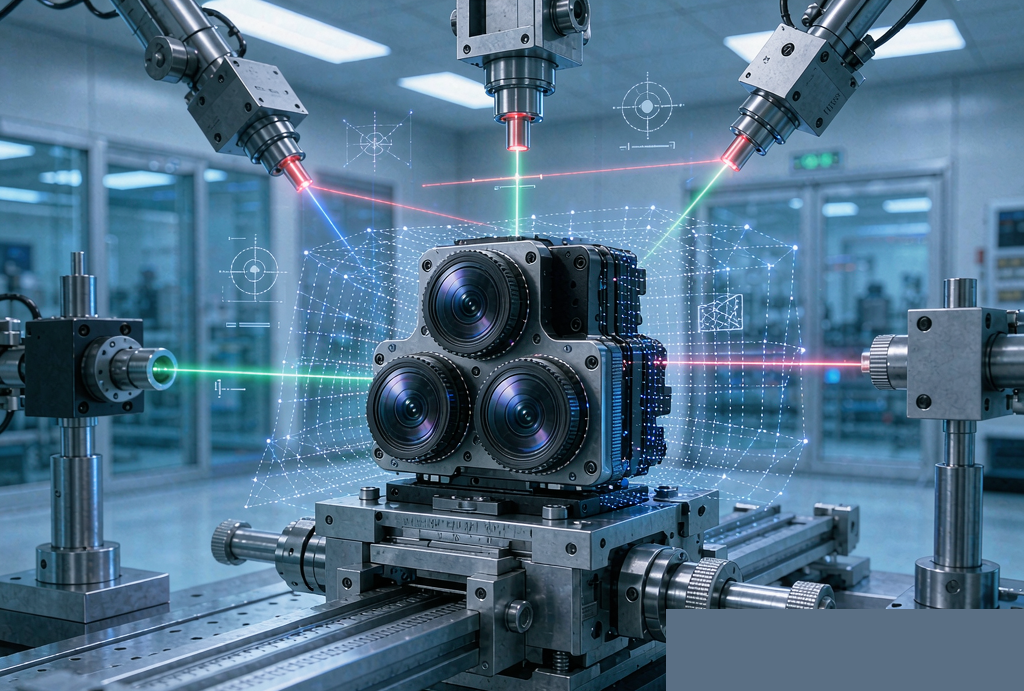
Whether using multi-camera stereo reconstruction or main-plus-telephoto viewpoint fusion, 3D reconstruction depends on precise inter-camera calibration and time synchronization. Traditional selection focuses on single-camera image quality, treating multi-camera coordination as a formality, leaving AI reconstruction unable to align multi-camera data.
Calibration precision directly determines 3D reconstruction geometric accuracy. If extrinsic parameters between main and telephoto cameras deviate at the sub-pixel level, the reconstructed 3D scene exhibits layer misalignment — subject and background separate in depth, and cloud AI fill produces visible seams at misaligned regions. Time sync issues are more severe in dynamic scenes: if inter-camera exposure timing differs by more than 1ms, moving subjects cannot align across cameras and reconstructed geometry distorts. Neither problem surfaces in single-camera evaluation; both appear only under the 3D reconstruction pipeline and cannot be fully compensated in post-processing.
Include multi-camera calibration and sync as module-level acceptance criteria. Require suppliers to provide extrinsic calibration data per module set (rotation matrix error ≤0.1°, translation error ≤0.1mm) and support OEM second-stage calibration. For time sync, evaluate whether the module supports hardware-triggered sync (≤500μs recommended) rather than relying on software timestamps. For solutions using serial interfaces like GMSL or FPD-Link, also assess interface fixed latency and jitter. Add a 3D reconstruction consistency test at acceptance: reconstruct the same scene from different camera combinations and control geometric variance within acceptable bounds.
3D reconstruction requires on-device transmission of depth maps, raw frames, and multi-camera sync data — far exceeding the traditional single-stream JPEG/YUV pipeline. Many selections inherit legacy interface bandwidth budgets, forcing the depth reconstruction pipeline to run in degraded mode under bandwidth bottlenecks.
The traditional module-to-ISP interface (MIPI CSI-2 D-PHY) was designed for single image streams. Under 3D reconstruction, the module must simultaneously output: main camera raw (14bit × 48MP ≈ 80MB/frame), depth map (16bit × 12MP ≈ 24MB/frame), and multi-camera sync data. At 30fps real-time reconstruction, total bandwidth demand reaches 3-4Gbps, approaching the limit of CSI-2 D-PHY four-lane. When bandwidth is insufficient, the system degrades: depth map resolution drops, frame rate drops, or raw data transmission is skipped — directly reducing reconstruction quality. A subtler issue: high bandwidth occupation squeezes ISP processing time, causing preview latency and autofocus lag.
Re-evaluate module-to-ISP interface bandwidth for 3D-reconstruction-capable flagship models. Upgrade to MIPI CSI-2 C-PHY (three-phase signal, ~2.5x D-PHY bandwidth) or CSI-2 D-PHY 5.0. Require modules to support multi-virtual-channel output, transmitting main raw, depth map, and auxiliary data over the same physical lanes via separate virtual channels to reduce pin count. Evaluate ISP parallel processing capacity to ensure the depth reconstruction pipeline runs in parallel with the normal imaging pipeline rather than competing for resources. Reserve 30% bandwidth headroom for future algorithm upgrades.
On-device 3D reconstruction inference (Spatial Core generating depth maps) depends on NPU compute, and NPU peak load power squeezes the thermal budget, indirectly affecting module operating temperature. Many selections evaluate module power and NPU power separately, causing module performance to degrade passively when system-level thermal limits are hit.
On-device 3D reconstruction at NPU peak load can draw several watts instantaneously. Sustained operation raises SoC temperature, triggering system-level throttling. Once throttled, ISP processing slows; if the module continues high-frame-rate output, buffer overflow and frame drops occur — manifesting as preview stutter and autofocus failure. Worse, SoC heat conducts through the motherboard to the module area, raising CIS dark current and noise, creating a vicious cycle of temperature rise, noise, and degraded AI reconstruction. If the module itself has weak thermal design, this surfaces earlier.
Build a module-NPU joint power budget model rather than evaluating separately. Require suppliers to provide module performance curves at different ambient temperatures (typically 25°C / 40°C / 55°C: SNR change, autofocus speed change) and evaluate the module's thermal path in the device. For 3D-reconstruction-capable models, position the module away from SoC heat sources or add thermal shielding. Evaluate whether the module supports dynamic frame rate adjustment — reducing output frame rate during NPU peak load to cut its own power and data volume, restoring full speed when the user triggers reconstruction. This co-design capability must be specified in the module datasheet, not left to OEM software adaptation after the fact.

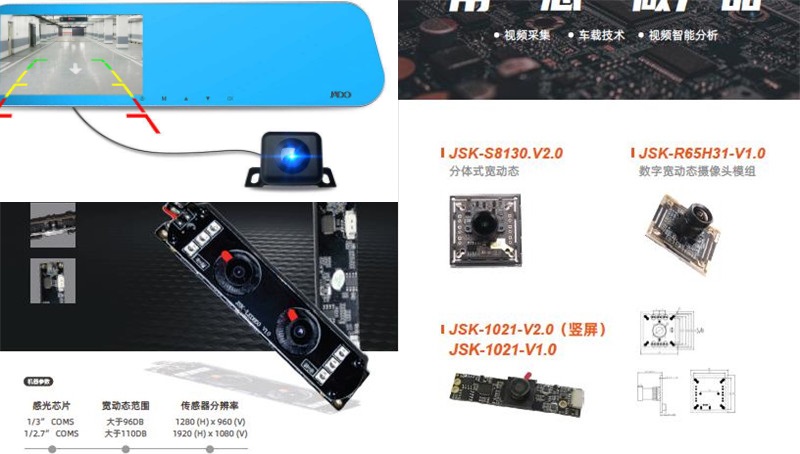
The emergence of Samsung Recompose fundamentally turns 3D perception capability from an optional bonus into a baseline requirement for flagship smartphone camera modules. Past selection focused on megapixels, sensor size, and aperture; future selection must also evaluate depth data source, raw frame quality, multi-camera calibration, interface bandwidth, and power co-design. JSK Technology specializes in camera modules across consumer electronics, automotive, security, and industrial inspection, accepting OEM/ODM orders and providing module solutions that support depth sensing and AI reconstruction pipelines for overseas customers. Contact us to discuss your selection requirements.
Not necessarily. On-device depth maps can come from dual-pixel phase detection (2PD), ToF/dToF, or multi-camera stereo. 2PD is lowest cost but limited at distance; ToF is accurate but degrades in strong light; multi-camera stereo is most robust but costs more and increases module size. Flagship models are recommended to use a 2PD plus dToF hybrid to cover all scenes.
Yes. Generative AI extrapolates texture and noise statistics from visible raw regions. Low SNR produces granular pseudo-texture in generated regions; insufficient HDR prevents highlight reconstruction. Recommended: single-frame SNR ≥38dB at 100lux, single-exposure dynamic range ≥90dB, RAW bit depth 14bit.
Significantly. Extrinsic rotation error exceeding 0.1° causes subject-background depth separation, with visible seams in cloud AI fill. Require suppliers to provide extrinsic calibration data per module set and support OEM second-stage calibration.
For 3D-reconstruction-capable flagships, yes. Traditional MIPI CSI-2 D-PHY approaches its bandwidth limit when carrying main raw plus depth map plus multi-camera sync. Upgrade to C-PHY or D-PHY 5.0, require multi-virtual-channel support, and reserve 30% bandwidth headroom.
Indirectly, yes. NPU peak load draws several watts; heat conducts to the module area, raising CIS dark current and noise. Build a module-NPU joint power budget, require supplier performance curves at 25°C/40°C/55°C, position modules away from SoC heat sources, and support dynamic frame rate adjustment.


AR0230---1/2.7 HD 2M Wide Dynamic
Fatigue Monitoring Camera Module
Motion DV Camera-720P-120 Degree Wide Angle Camera Module
Night Vision Monitoring Camera Module
Monitoring - Doorbell - Law Enforcement Instrument Camera Module
Ten Thousand Trillion Industrial Camera Camera Module
 13423810014
 0755-29433686
 daming@cameras-module.com
 2/F, Building H, Zhiyihan Industrial Park, Yuanling Village, Shiyan Town, Baoan District, Shenzhen 518108



We use cookies to enhance your browsing experience. Continuing to browse indicates that you agree to our cookie policy.